He Toa Whawhai Mō Ōna Iwi
Winiata Te Wharo was born c.1825 at Te Koutu on the Rangitīkei River. His mother Kinokino, and father, Turitakoto, raised him with intimate knowledge of the whenua, wai and all natural resources. He was also fluent in the traditional knowledge of his people, whakapapa and culture. His whakapapa (genealogy) from Indigenous pre waka iwi and Tākitimu provide unquestionable mana whenua over vast tracts of land.
He fought at the battle of Ōrākau in 1864, answering the call for iwi support to thwart off invading colonial troops. A few years later, another call for assistance from even closer kin, saw him fight alongside Rēnata Kawepō.
Gleaning information from newspaper articles and letters, Winiata had a good mind for business, was highly intelligent and could think laterally to overcome problems. He was steadfast and resolute in his pursuit of justice, and he fought hard and long at great personal cost for hapū and iwi whenua.
By 1868 he had married Pēti Mokopuna Hamilton. Pēti was born in Ōtaki in 1850 and descends from Tainui Waka via Ngāti Raukawa and Ngāti Wairangi; Te Arawa Waka via her Tūwharetoa, Ngāti Te Kōhera side and Tākitimu Waka through Ngāi Te Upokoiri.
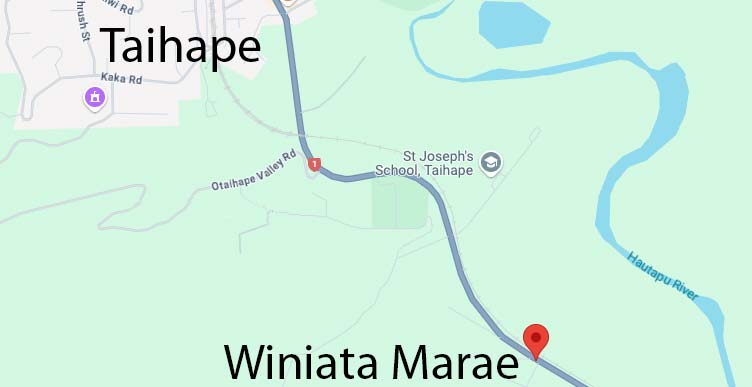
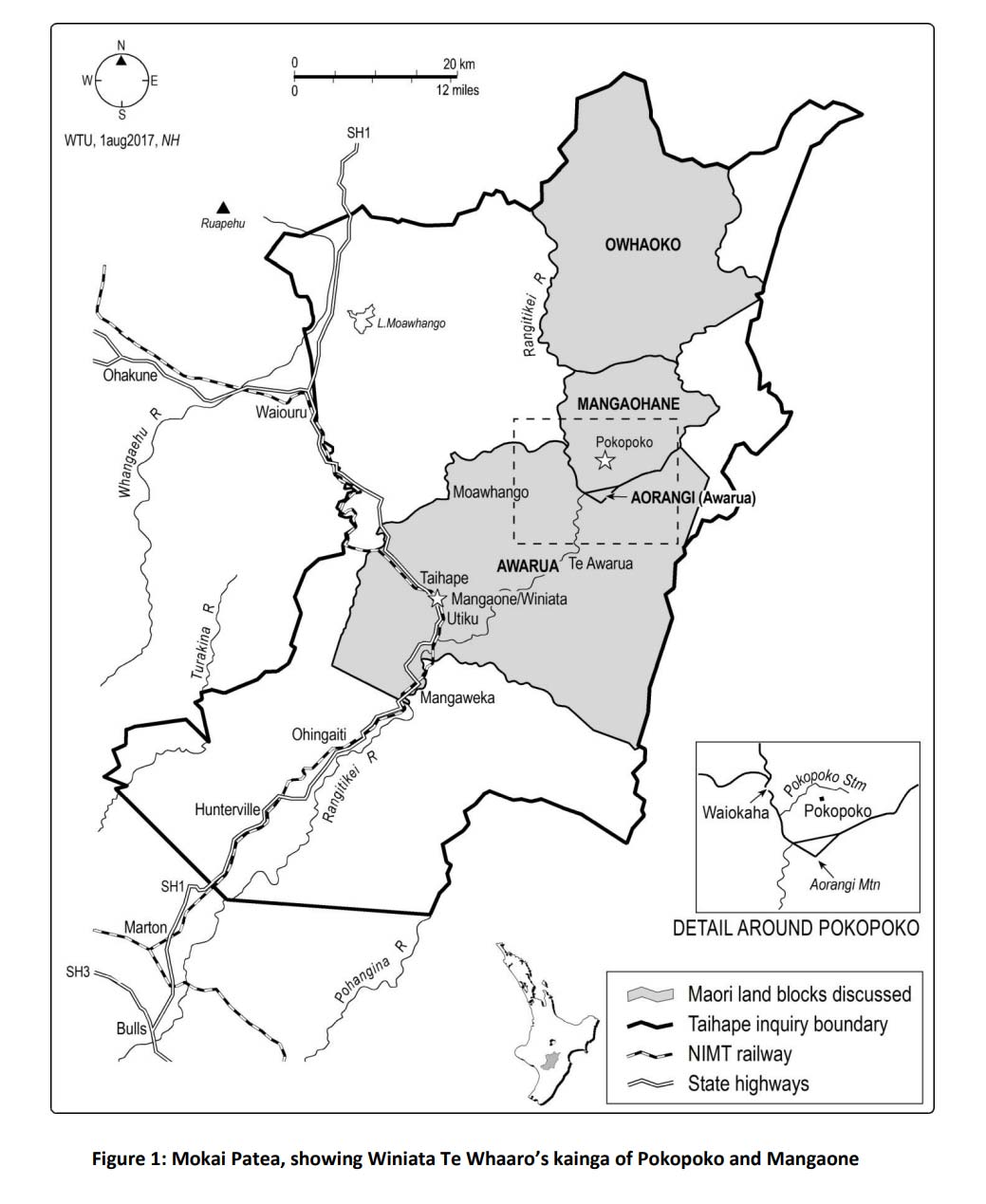
Near the end of the 1870s Winiata Te Wharo was one of several rangatira within Mōkai Pātea who took up a career farming sheep, beginning at Waiokaha (see map for location). After a short stay there, he moved his stock and family to more fertile whenua at Pokopoko.
Pokopoko is part of an extensive and fertile block of land named Mangaōhane, firmly nestled within Ngāti Paki lands. Water, food, firewood and native grasses (which made excellent grazing) were all plentiful at Pokopoko. It was not long before a small, thriving community was established with a wharepuni, a shop, a church, wooden homes, a “woolshed clad in manuka bark", a "fenced stockyard" and extra houses used year after year for shearing. Hapū and whānau numbers also increased and prospered, and Pēti birthed the seven youngest of their children at Pokopoko.
John Studholme coveted the lush Mangaōhane lands and engaged Walter Buller, a prominent lawyer, and others, to help him attain the land. Beginning in December 1879, he dragged Winiata through the courts with relentless litigation.
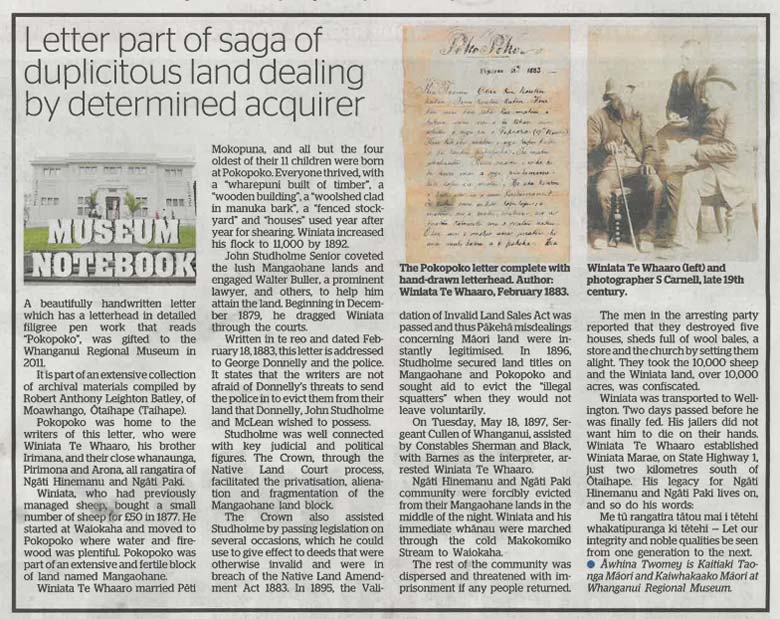
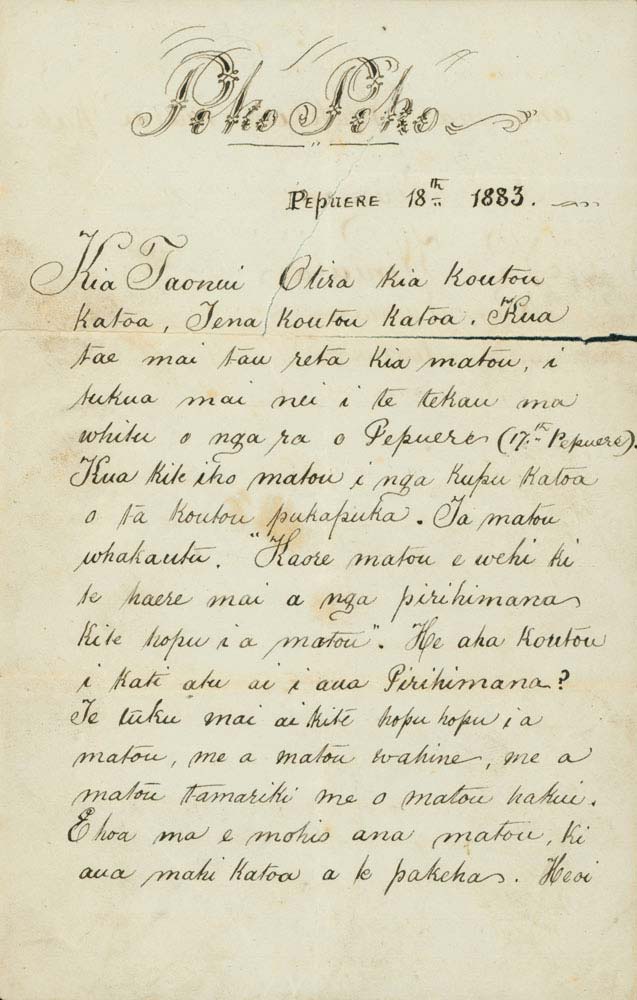
This letter, accessioned into the Whanganui Regional Museum as part of the Batley Collection, was written by Winiata Te Wharo, his brother Irimana, and their close whanaunga, Pirimona Te Urukahika and Arona Te Raurimu. They were all recognised rangatira of Ngāti Hinemanu and Ngāti Paki at that time.
This letter is a reply to George Donnelly (Taonui) and his friends being John Studholme Snr, John Studholme Jnr and their lawyers Walter Buller, and Messrs Bell and McClean stating they were not scared of their threats to send the police to forcible remove them from the land.
Donnelly had married a female relative of Winiata, being Airini, a niece of Rēnata Kawepō. His networks were very influential with government and settlers.
Studholme, like Donnelly, was well connected with key judicial and political figures, and they pressed their networks - the Crown, through the Native Land Court process, facilitated the privatisation, alienation and fragmentation of the Mangaōhane Land Block.
The Crown also assisted Studholme by passing legislation on several occasions, which he could use to give effect to deeds that were otherwise invalid and were in breach of the Native Land Amendment Act 1883.
In 1895, the Validation of Invalid Land Sales Act was passed and thus underhanded Pākehā misdealings concerning Māori land were instantly legitimised. In 1896, Studholme secured land titles on Mangaōhane and Pokopoko and sought aid to evict the "illegal squatters" when they would not leave voluntarily.
On Tuesday, May 18, 1897, Sergeant Cullen of Whanganui, assisted by constables Sherman and Black, with Barnes as the interpreter, unlawfully and illegally arrested Winiata Te Wharo. The Ngāti Hinemanu and Ngāti Paki community were forcibly evicted from their Mangaōhane lands in the middle of the night. Winiata and his immediate whānau were marched through the cold Makokomiko Stream to Waiokaha. The rest of the community was dispersed and threatened with imprisonment if any people returned, no-one was allowed to return to their working farm which provided their livelihood, and they were all b rendered landless in their own homeland as a result.
The men in the arresting party reported that they destroyed five houses, sheds full of wool bales, a store and the church by setting them alight. They took the 10,000 sheep and over 10,000 acres.
Winiata was transported to Wellington and two days passed before he was finally fed - as his jailers did not want him to die on their hands. He was given the ultimatum that if he wanted to be released from jail to return home to his wife, tamariki and the hapū, then he must promise to never return to Pokopoko.
True to his word, and with a family to care for, Winiata Te Wharo gave the court his word. He established Winiata Marae, on State Highway 1, just two kilometres south of Ōtaihape. His legacy for Ngāti Hinemanu and Ngāti Paki lives on; unfortunately, his descendants still battle for the return of the stolen lands.
MATE KĀINGA TAHI, ORA KĀINGA RUA
Letter part of saga of duplicitous land dealing by determined acquirer
Click to view larger version
'Whanganui Chronicle, Monday, June 24, 2019'
Additional Article: Museum Notebook: Pokopoko letterhead gifted to museum - NZ Herald
Click to view larger version
Click to view larger version
English translation of the Poko Poko letter dated, 17 Feb 1883.
Poko Poko
February 18th 1883
To Donnolly, Indeed to you all, salutations. Your letter has arrived to us, sent here on the seventeenth day of February (17th February).
We have seen every word that you have written in your letter. Our reply, “We will not be afraid if policemen come to arrest us.”
Why did you obstruct those Policemen? Instead of sending them to arrest us, our wives and our children plus our elderly women. For goodness sake, we know all such practises of the pākehā.
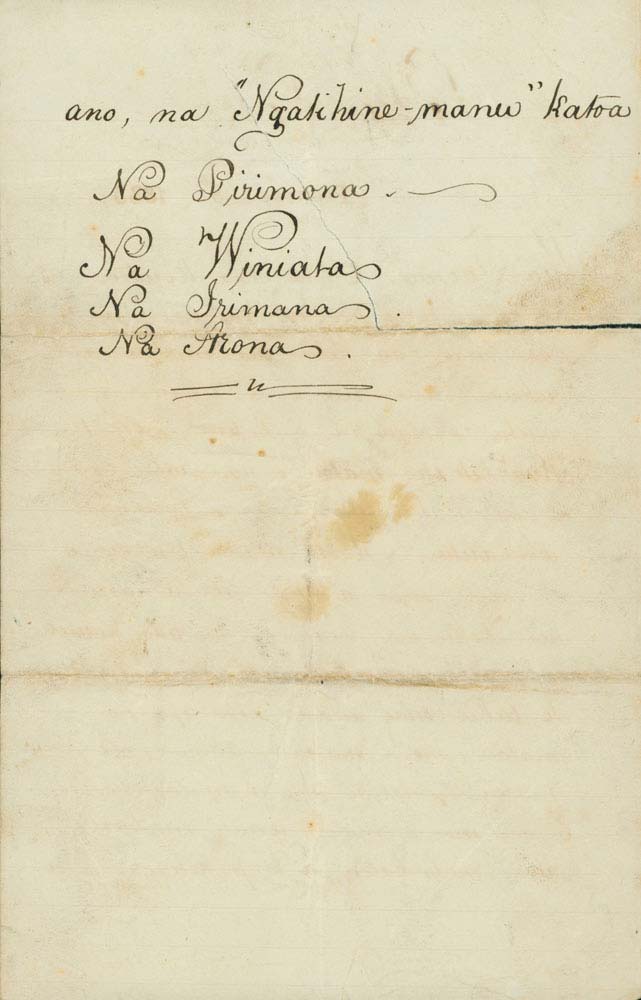
That is all, from all of Ngāti Hinemanu
(signed) Pirimona
Winiata
Irimana
Arona
Click image to enlarge
Mōkai Pātea, showing areas that Winiata Te Whaaro established kāinga/homes: Waiokaha, Pokopoko and Mangaone (Winiata Marae), Ōtaihape/Taihape. Source: Waitangi Tribunal Report, Wai 2180, #A56, The Arrest of Winiata Te Whaaro and the Eviction of the Pokopoko Community, pg 8, Map 1.
Click to view larger version
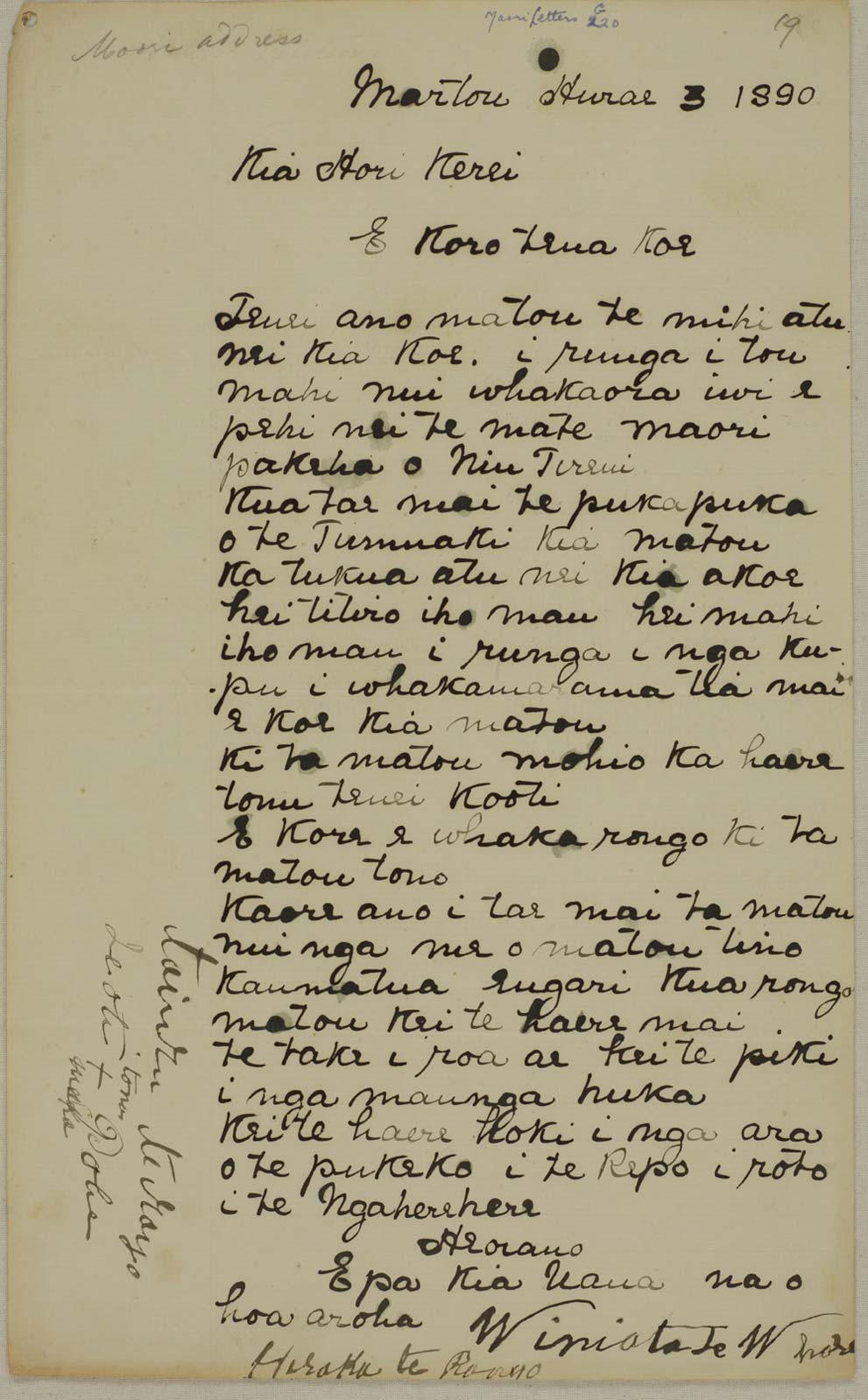
Letter to Hōri Kerei/Governor George Grey by local rangatira: Winiata Te Wharo, Hiraka Te Rango, Te Oti Pohe and Taiuru Te Rango (?). Written July 3rd, 1890, in Marton
Our tīpuna are dismayed that a court hearing is to proceed when most of their relations including their most knowledgeable kaumātua are still trekking long arduous paths, traversing snow laden mountains, swamps and forests to get to the hearing so they can give evidence. They hope Hōri will honour his previous statements to them by instructing the court to wait. (It seems the court date has been brought forward considerably)
Mid-winter Land Court Hearings, held at a distance from the actual land being discussed, came at a huge financial and physical loss to Māori. This ploy, commonly utilised by the government, its court system and greedy land grabbers made it easier to relieve Māori of their whenua. Many tīpuna ran into great debt while defending their land titles as they needed to buy food, provisions and lodgings for many weeks as court cases dragged out – meanwhile the land was unprotected and unable to be utilised or prepared for economic sustainability. Judges often adjourned hearings for a week at a time during cases, and as a week was too short to travel home and back, our tīpuna had to wait, and were sometimes rewarded with another adjournment.
Judges were also known to move the case to another area altogether to be heard, without sufficient allowance for Māori to arrive at the new venue. They also scheduled two or more hearings in different areas at the same time which involved the same landowner, meaning owners would have to decide which land to keep, as the other undefended cases would be lost. Debts to shopkeepers, boarding establishments, lawyers, the court and surveyors, were most often recovered by taking parcels of the very whenua tīpuna were trying to defend.
Many Māori, especially kaumātua, died from the hardships of the journey – either succumbing to illnesses caused by either the arduous travel or sleeping in tents or outside the courthouse on the sidewalk in freezing conditions when funds were depleted, or lodgings were unavailable for Māori.
Rēhita Mai
Register Now
"Ehara taku toa i te toa takitahi, engari he toa takitini"
"Success is not the work of an individual, but the work of many."
We are stronger with your support. You can start an application for membership online by completing our registration form.